Accurately managing inventory across retail environments—whether in grocery stores, farm supply stores, alcohol stores, or wholesale clubs—is one of the most significant challenges retailers face today. Maintaining real-time visibility into stock levels, pricing accuracy, and product locations is equally complex. Manual audits are slow, labor-intensive, and prone to errors, leaving critical gaps that directly impact sales, customer satisfaction, and profitability.
The longer items remain unstocked, the more sales dollars are left on the table, not to mention the damage to shopper loyalty. Incorrect price tags further complicate matters, exposing businesses to potential fines and eroding customer trust. Without precise, actionable insights into inventory levels and store conditions, these issues persist, creating ripple effects across the entire business.
Retail leaders are turning to cameras as a solution to this problem. But not all cameras are created equal, and using the right type, or a combination of types, can be the difference between thriving and falling behind. Fixed cameras and autonomous mobile robots (AMRs) each bring unique strengths to the table, and when used together, they can save retailers up to 5% in operating margin and increase revenue by 4.5% annually through better inventory management.
What are fixed cameras and autonomous mobile robots?
Both fixed cameras and autonomous mobile robots capture in-store data to serve the same general purpose, monitoring and improving inventory management. Understanding their key differences—mobility, coverage, data quality, and capabilities—is essential for determining the best fit for your store.
Fixed Cameras
Fixed cameras are mounted on shelves, walls, or ceilings to monitor specific areas regularly. They are well-suited for high-frequency monitoring in targeted zones but lack mobility, limiting their ability to adapt to dynamic store layouts. Their field of view is static, and capturing detailed data such as shelf depth and shelf tags can be challenging.
Autonomous Mobile Robots
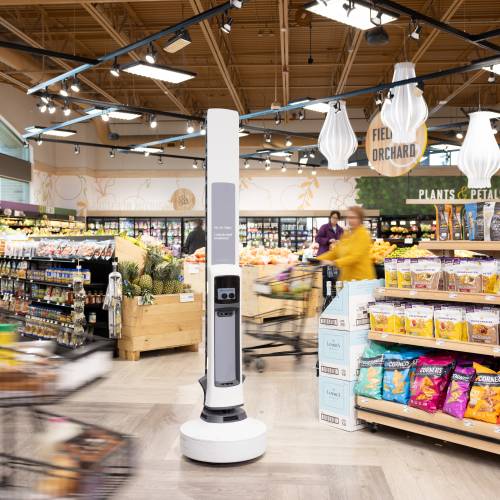
Autonomous mobile robots like Simbe’s Tally roam the store, capturing precise, high-fidelity data. These robots adapt to changing layouts and traverse aisles, collecting accurate inventory counts, pricing insights, and real-time product locations. Their mobility allows them to capture more data with fewer devices, making them an ideal solution for dynamic, medium- to large-format stores like grocery or wholesale environments.
When to Use Fixed Cameras
Fixed cameras shine in use cases requiring higher-frequency monitoring, such as:
- High-Turnover Areas: Continuous monitoring of sections like fresh foods, produce, and prepared meals to ensure items are replenished.
- High-Theft Zones: Keeping an eye on valuable products like alcohol, medicine, and electronics to prevent shrink.
- Checkout Zones: Monitoring bottom-of-the-basket items to ensure accurate scanning at checkout.
Where fixed cameras fall short
While effective for specific high-frequency use cases, fixed cameras face challenges when implemented in larger retail environments.
- Limited Range and Coverage Gaps: Fixed cameras are stationary, restricting their field of view and leading to coverage gaps in larger spaces. Scaling their use to medium or large stores often requires hundreds of cameras, significantly increasing costs and complexity.
- Reliance on Planograms: Fixed cameras depend on planograms—static diagrams of expected shelf layouts—which are often outdated or inaccurate. By contrast, robots like Tally create a realogram, dynamically mapping actual shelf conditions and eliminating the need for planograms. Fixed cameras like Tally Spot can then enhance this realogram with high-frequency updates in critical areas.
- Lower Image Quality and Accuracy: Fixed cameras often lack the resolution to capture detailed inventory data, such as shelf depth or barcodes, leading to missed out-of-stocks or incorrect counts.
- High Maintenance Costs: Scaling fixed cameras requires significant infrastructure, such as mounting hardware and wiring. They are prone to damage in high-traffic areas, and frequent maintenance can drive up costs.
While fixed cameras offer value for targeted monitoring, their limitations make them impractical for full-store coverage. Pairing fixed sensors with mobile robots offers a more comprehensive and cost-effective solution.
When to Use Autonomous Mobile Robots
Robots like Tally are ideal for full store coverage, providing:
- Broad Coverage: Scanning aisles and tall shelves with fewer devices.
- High-Fidelity Data: Reading detailed barcodes, shelf depth, and product locations with precision.
- Dynamic Flexibility: Adapting to layout changes and supporting online order fulfillment with real-time inventory insights.
- Reduced Infrastructure Requirements: Minimal setup, with just a charging station and WiFi connection needed.
For medium- to large-format stores, autonomous mobile robots are better suited to manage inventory by providing high-quality, real-time information about inventory count, item location, and price and promotion accuracy. Robots cameras are also precise and sophisticated enough to read minute details of shelf tags and measure shelf depth accurately to understand when items are low, not just entirely out. This added visibility can even help warehouses and wholesale clubs gather comprehensive data from their highest steel shelves, more than several feet above a store associate’s direct line of sight with fewer devices.
Multimodal Approaches: The Best of Both Worlds
Combining fixed sensors and autonomous mobile robots delivers unmatched visibility for retailers. Fixed sensors like Tally Spot excel in critical zones requiring high-frequency monitoring, while robots like Tally provide scalable coverage throughout the store. Together, these technologies create a seamless, complementary system that maximizes data capture and operational efficiency.
Key advantages of a multimodal approach include:
- Targeted Precision: Fixed sensors monitor high-value or theft-prone areas continuously, while robots handle dynamic, broad coverage.
- Enhanced Data Quality: Robots like Tally generate high-fidelity realograms, which fixed sensors supplement with frequent updates in critical zones.
- Cost Optimization: A balanced mix of fixed sensors and mobile robots reduces the need for extensive infrastructure while achieving comprehensive store visibility.
For example, fixed cameras in checkout zones can monitor bottom-of-basket items continuously, while robots scan the rest of the store for price accuracy, shelf depth, and inventory counts. By pairing these technologies, retailers gain a seamless, complementary system that reduces shrink, enhances efficiency, and improves customer experiences.
The Bottom Line: Understand the Objective
Fixed sensors and autonomous mobile robots each serve distinct purposes in retail. Fixed sensors are ideal for high-frequency monitoring in targeted areas, while robots provide the flexibility and scalability needed for broader store coverage. When deployed effectively, they ensure accurate inventory management, reduce shrink, and free up store teams to focus on creating better shopper experiences.
Retailers no longer have to choose between fixed or mobile cameras—they can leverage the strengths of both to drive results.
Only Simbe offers multimodal shelf intelligence solutions proven to deliver chain-wide value at global scale, while delighting shoppers and store associates. To see Simbe’s multimodal platform in action, schedule a demo today.